


Polare
Helping households shift electricity use to the cheapest, cleanest hours — without becoming an energy expert to do it.
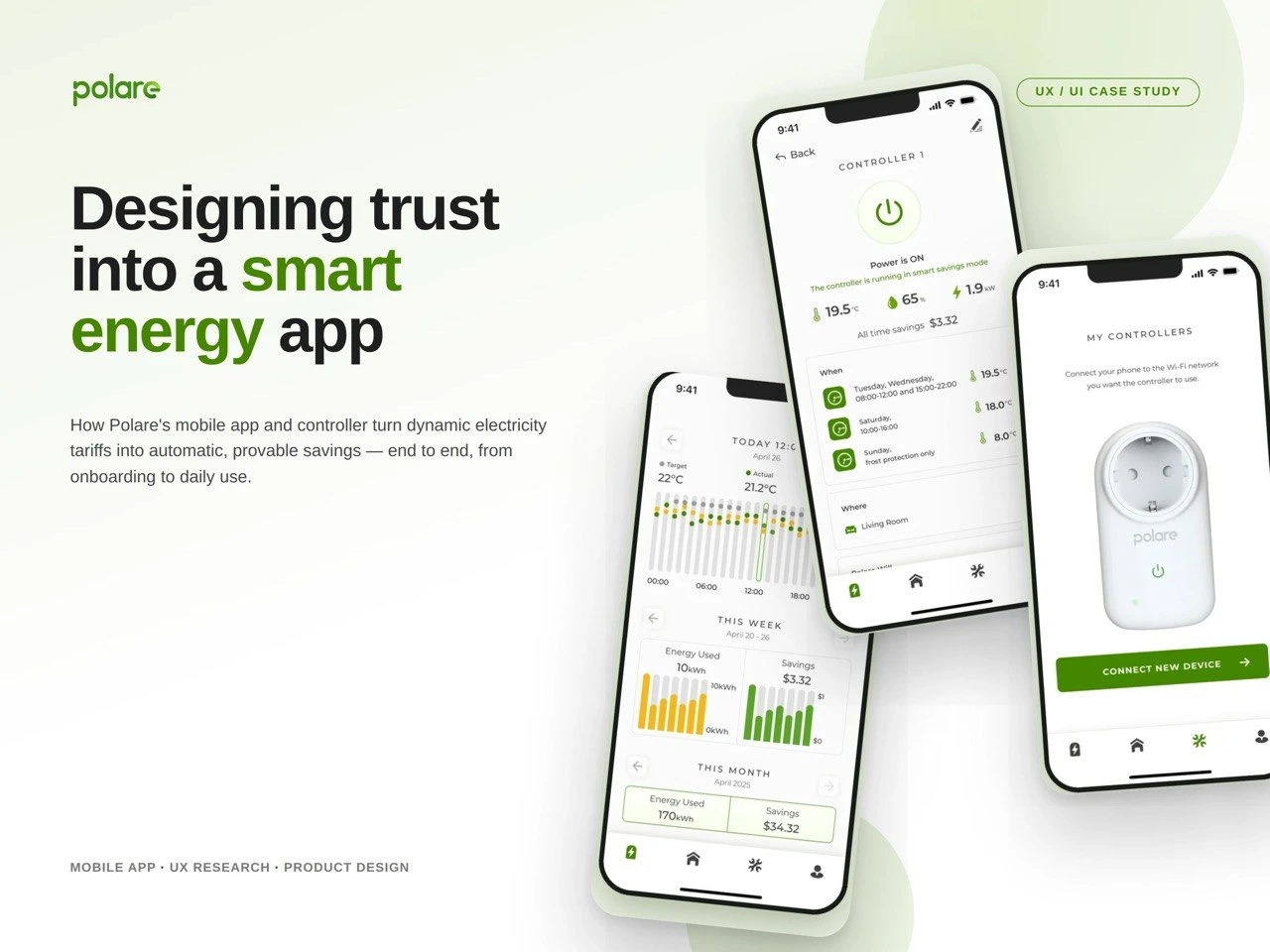
Electricity got a schedule. Most people never learned it.
Dynamic and time-of-use tariffs are spreading fast across Europe, priced hour by hour instead of a flat rate. The savings are real, but capturing them means shifting laundry, charging and heating into the cheap windows — something almost nobody has time to track by hand.
The shift is uneven and largely regulation-led rather than consumer-led. Nordic, Benelux and UK markets already treat spot-price-linked tariffs as mainstream; Germany made dynamic tariffs mandatory for suppliers to offer under §41a EnWG in 2025, pulling DACH households into the market faster than demand alone would have. That gap between "the tariff exists" and "the household actually benefits from it" is where Polare sits.

Two households, two reasons to automate
Interviews and the JTBD work below kept surfacing the same split: one household is optimizing money they already track closely, the other wants the savings but refuses to spend attention on it. Polare has to work for both without asking either to behave like the other.
Lars, 34, software engineer, Berlin. Just switched to a dynamic tariff after Germany's 2025 mandate. Already tracks spending in a budgeting app and enjoys seeing a number go down.
Goal: Push savings as close to the theoretical maximum as effort allows, without babysitting a spreadsheet of hourly prices.
Frustration: Existing tariff apps show him the price curve but expect him to personally remember to run the dishwasher at 2am.
Petra, 58, teacher, Vienna. Moved to a dynamic tariff because her supplier defaulted her onto one. Owns a smart speaker but avoids anything that "feels like more admin."
Goal: Save some money on the bill without learning how electricity pricing works.
Frustration: Assumes automation this "set and forget" must be too good to be true, or too fiddly to set up alone.
Personas are composites built from the JTBD interviews and the adoption-barrier research cited below, not individually identifiable research participants.
Everyone shows the price. Almost no one closes the loop.
The category splits into two camps: tariff apps that surface hourly prices and expect the household to act on them, and smart plugs that automate one device well but stay blind to the tariff itself. Polare's opening is the gap between the two.
| Product | Category | Strength | Gap for our user |
|---|---|---|---|
| Tibber | Tariff + app | Clear live pricing, strong brand trust | Ties you to one supplier; automation needs their own hardware |
| Shelly Plug S | Smart plug | Cheap, reliable, huge install base | No tariff awareness — schedules are fixed clock times, not prices |
| Ohme Home Pro | EV charger | Excellent tariff-aware EV charging logic | Single-purpose — only helps if you own an EV |
| Sense | Energy monitor | Rich, granular usage insight | Monitoring only — it explains the bill but can't act on it |
| Polare | Plug + app | Works with any supplier and any plugged-in appliance; automates around the live tariff | — |
What people are actually hiring Polare for
I want to shift my washing machine and dryer into the cheapest hours automatically,
so I can save money without setting an alarm to do laundry at 2am.
I want to see, in plain numbers, what shifting my usage saved me this week,
so I can trust the automation enough to stop double-checking it.
I want to override the schedule with one tap,
so I can stay in control instead of fighting the app.
I want to get a device running in under a couple of minutes without reading a manual,
so I can feel like this was worth buying before I've even used it.
I want to get real value from the very first day, not after a week of configuration,
so I can avoid becoming another abandoned gadget in the drawer.
The last job reflects a well-documented pattern in the category: independent research (Parks Associates, cited by Strata-gee, 2024) names setup complexity, not price, as the leading reason smart-home devices go unused after purchase.
Where trust is won — and where it's lost
The map below tracks a first-time user across five stages. Two moments carry the most risk: setup, where a single confusing step can end the relationship, and the first week, where the app has to prove it's actually doing something before the person tunes it out.
| Awareness | Setup | First week | Daily use | Advocacy | |
| Doing | Hears "cut your bill" and checks if their supplier offers a dynamic tariff. | Unboxes the plug, connects Wi-Fi, links their electricity supplier. | Checks the app daily to see if automation actually ran. | Glances at the app occasionally; overrides schedules when plans change. | Sees the monthly savings summary and mentions it to a housemate or neighbor. |
| Feeling | 🤔 | 😬 | 🧐 | 🙂 | 😄 |
| Pain point | Unsure if their own habits are "flexible enough" to benefit. | Supplier-linking is the one step people abandon the flow on. | No visible proof of savings yet — feels like it might be doing nothing. | Worried an override today will silently break tomorrow's schedule. | Savings feel abstract without a "compared to before" baseline. |
| Opportunity | A savings estimate before purchase, from just a postcode and appliance list. | Let a manual tariff entry unblock setup instantly; link the API quietly in the background. | A day-one push notification: "Your dryer ran in the cheapest hour today — saved €0.42." | Overrides are explicitly one-time by default, with the return-to-schedule shown up front. | A shareable monthly recap comparing this month to a pre-Polare baseline. |
Designed to be understood at a glance
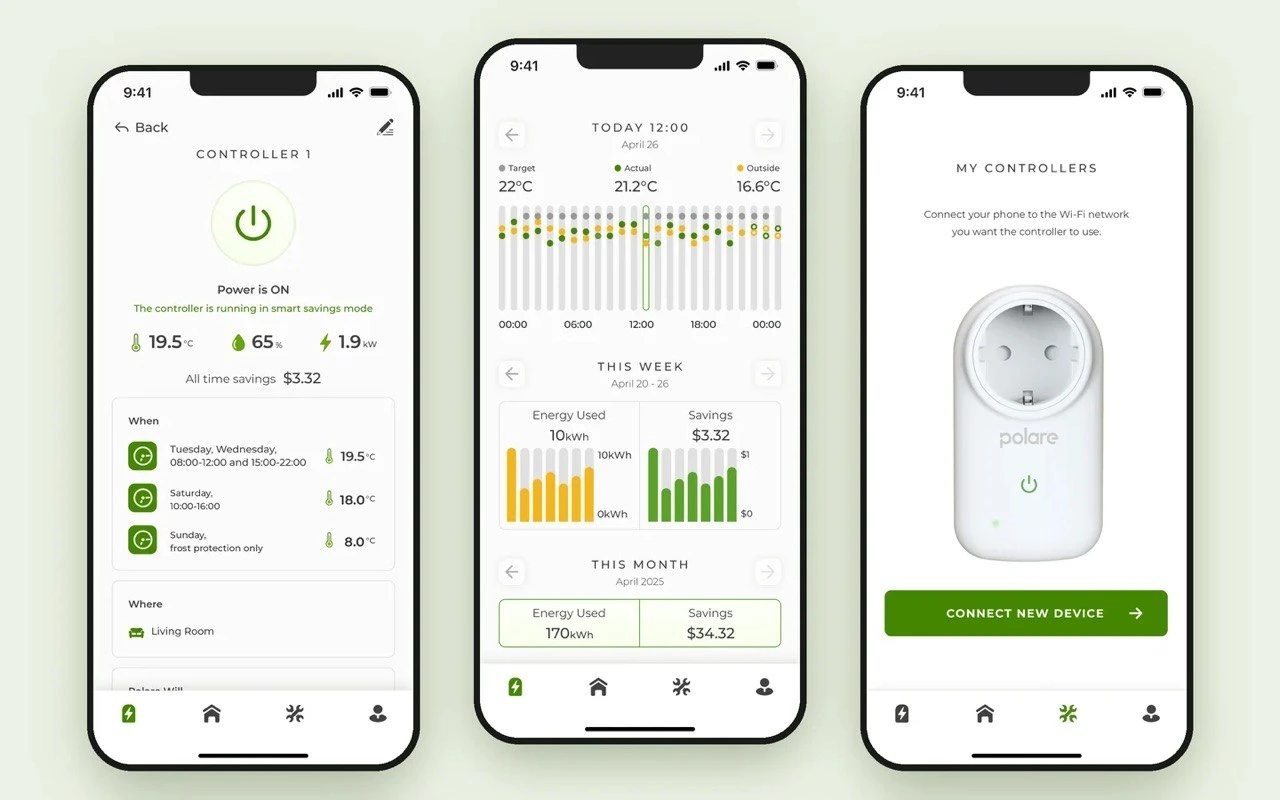
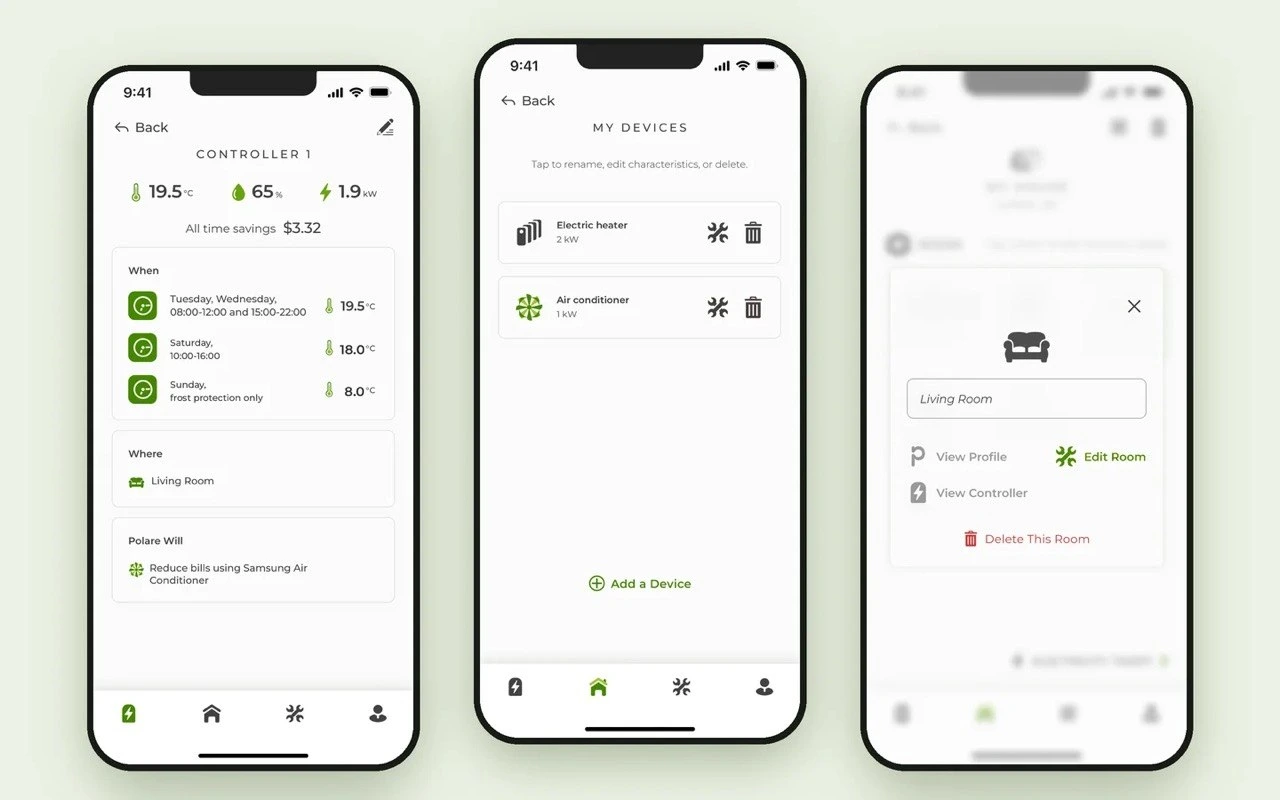
Real screens from the shipped app: the controller detail view with schedule and live readings, the today/week/month usage-and-savings breakdown, and the device-management flow for connecting and organizing controllers by room.
Reading the curve, not just the average
Polare doesn't just avoid "expensive" hours — it looks for the lowest contiguous window long enough for a full appliance cycle, then times the run to land inside it.
What the design was built to deliver
Figures on this page combine third-party industry research (cited in Section 01) with product design targets; they describe the category's benchmarks and this design's intent, not measured in-market results for Polare specifically.
A funnel built to prove savings before asking for money
Before there was an app to design, there was a harder problem: convince someone to buy a smart plug they've never heard of, on the promise of savings they can't yet see. Every design choice in the funnel below exists to close that trust gap one step earlier than the site could otherwise afford to.
"How much can we save you?" asks nothing of the visitor yet — no signup, no device explanation. It trades a generic pitch for a personal number, which is the one thing a smart-plug landing page can promise that a competitor's spec sheet can't.
Every question is a chance to drop off before the visitor has seen any payoff. The form only asks what the savings math actually needs — location, property type, and the devices being heated or cooled — nothing collected for later marketing use, because that trade wasn't worth the completion rate here.
A calculator that always says yes stops being evidence — visitors learn to discount it the same way they discount "you could be a winner!" copy. Letting Polare tell some visitors it isn't worth it for them is what makes the "yes" result credible enough to act on.
The property and device details entered in the calculator are the same ones the app needs during setup. Carrying that profile from pre-order into the account means a buyer answers those questions exactly once — not once to get quoted and again to get the device working.
Funnel structure and the ~€30 controller / ~€40 first-year / ~€25 additional-controller pricing shown here reflect the 2023 planning wireframes this was modeled from, not current live pricing.